
Why Festivals Matter
A philosophical reflection on matsuri, leisure, and the pleasure of being together

Contemporary societies provide many kinds of entertainment, and we are all used to being entertained in one way or another. Yet entertainment is not simply a distraction or a product to consume. It is also one of the ways a society shapes its values and gives people a temporary image of what it means to belong together.
If the primary goal of entertainment is often to make a profit, that is still only one layer of the phenomenon. What we usually experience as entertainment also serves a social function. It provides people with an opportunity to temporarily escape the pressures of everyday life.
This is especially clear when entertainment is produced not only for spectators but also by the people who live within the community it represents. In that case, entertainment becomes closer to a ritual. It is a repeated act through which a group remembers itself, renews its bonds, and gives a public form to an otherwise invisible feeling of belonging.
In this post, I would like to discuss a very popular form of Japanese entertainment: local festivals, or Matsuri 祭り.
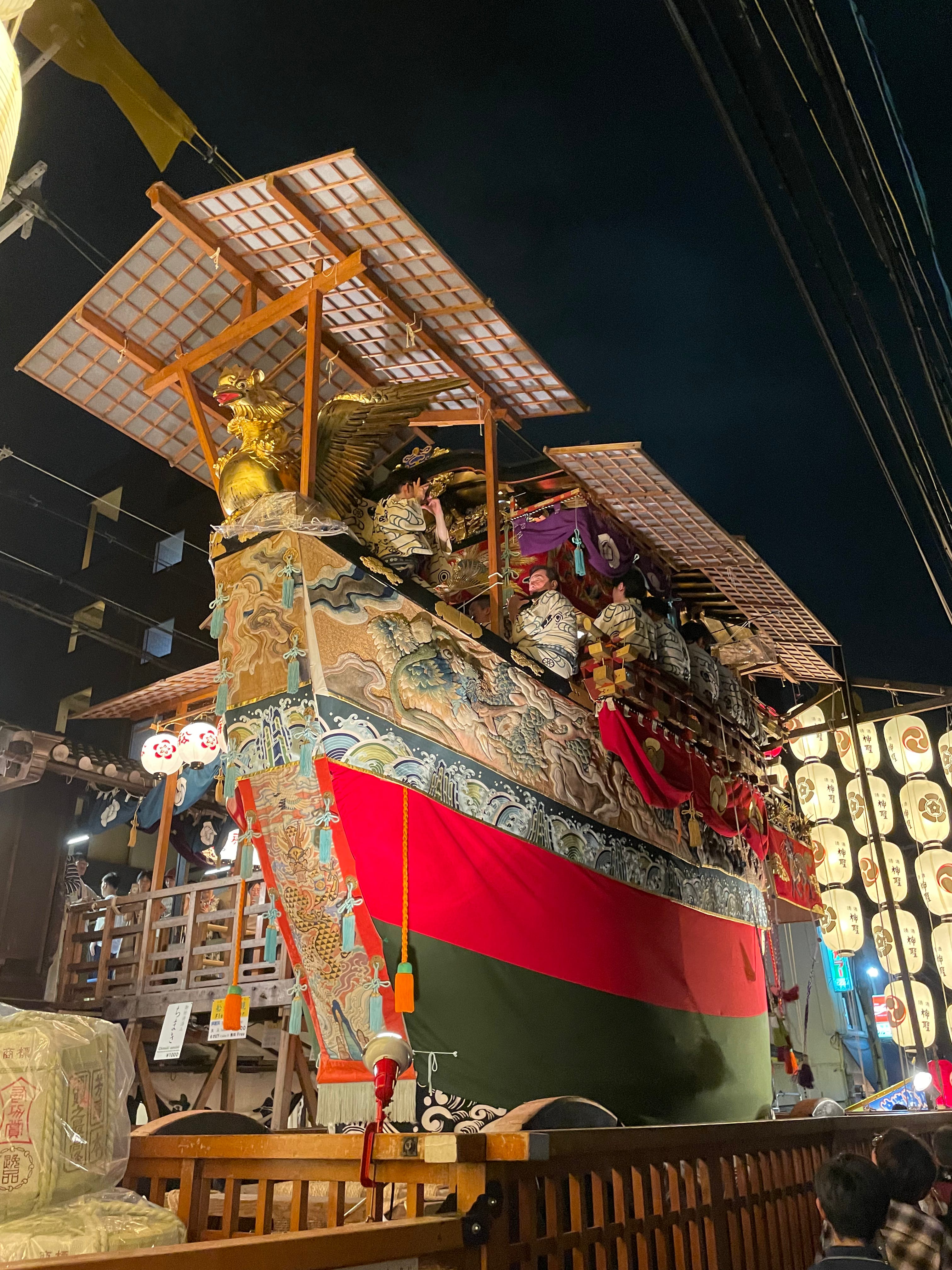
At the end of this post, I will add pictures taken this year during Gion Matsuri. I will comment on the pictures to show you what must be noticed and understood concerning these events. These are insider insights, but reserved for my paid subscribers as a “thank you” for their long support.
Matsuri as Entertainment
Local festivals are very popular in Japan, but their popularity cannot be understood solely in terms of tourism or leisure. From Gion Matsuri 祇園祭, Kyoto’s most famous festival, to Awa-odori 阿波踊り, considered the largest dance festival in Japan and held in Tokushima in August, these events convert a city into a symbolic space and produce collective identity.
Each year, they draw many local residents and tourists into the same streets, where celebration, commerce, and community briefly converge. While hotels, restaurants, and souvenir shops certainly benefit from the influx of people, the festival cannot be reduced to its economic effects alone.
Its importance also becomes clearer when placed against the pressures of ordinary life. Even in a peaceful country, daily life can be tiring, impersonal, and socially demanding.
Local festivals offer people a time to breathe, enjoy local life or tourism, grab some food, and walk through crowded streets where the individual body becomes part of a bigger and more joyful community. The crowd is then part of the experience, making belonging physically manifest.
In The Elementary Forms of Religious Life (1912), Durkheim called this kind of shared intensity “collective effervescence” (effervescence collective), a moment when people gathered together feel themselves carried beyond individuality. The crowded street is therefore part of the festival’s social force.
Local festivals are a form of entertainment that allows people to take a break, and this break is not just physical. It is an existential time-out. It is a moment when the usual routine of work and social pressures is temporarily replaced by a collective effervescence.
Matsuri as the Cement of Local Community
Of course, this kind of entertainment is not simply a short breath that helps people endure difficulty. It is also a practice through which local communities reproduce themselves. Matsuri relates to community in two connected ways:
Local communities take part in organizing the festivals themselves.
The festivals help maintain local solidarity among generations.
Let’s take the example of the Gion matsuri 祇園祭. Various communities are involved in organizing the various elements that make up this event. At a higher level, an association oversees the whole thing to ensure everything goes well.
Before the festivities, you can hear people practicing traditional music in the city. These sounds are signs of transmission, as some communities preserve the tradition by passing on specialized knowledge to local musicians.
A few days before the event, you can also see people building floats and setting up decorations on the main streets. This labor shows everybody that the festival is the result of a collective effort.
It is organized by local communities that do their best to create pleasant and popular festivities. The event is then at once a gift and a duty. It is something offered to others while also endorsing the community’s own existence.
Rousseau’s critique of theater expressed concern that spectatorship could render citizens passive, transforming public life into an event that people merely observe. In contrast, Matsuri demonstrates that festivals are richer when people are both spectators and participants in a shared civic event.
Conclusion
Local festivals are a form of entertainment, and they are certainly connected to business. But entertainment is not only the act of amusing people or helping them think about something other than their ordinary concerns. At its deepest level, it can also be a social technology: a way of giving form to memory and community.
A Matsuri is a creation that requires one group to produce it and another to enjoy it, but the relation between producer and spectator is never purely passive. Even more commercial creations, such as dramas, are more than mere entertainment. They can become shared references, common memories, and occasions for conversation with friends and loved ones.
They are always potential shared activities that make life more delicious. Still, their deepest value lies in reminding us that a society is held together by repeated moments of celebration, by the pleasure of being together, and by rituals that must be renewed before they disappear.
Sounds very similar to many religious ceremonies or festivals.